

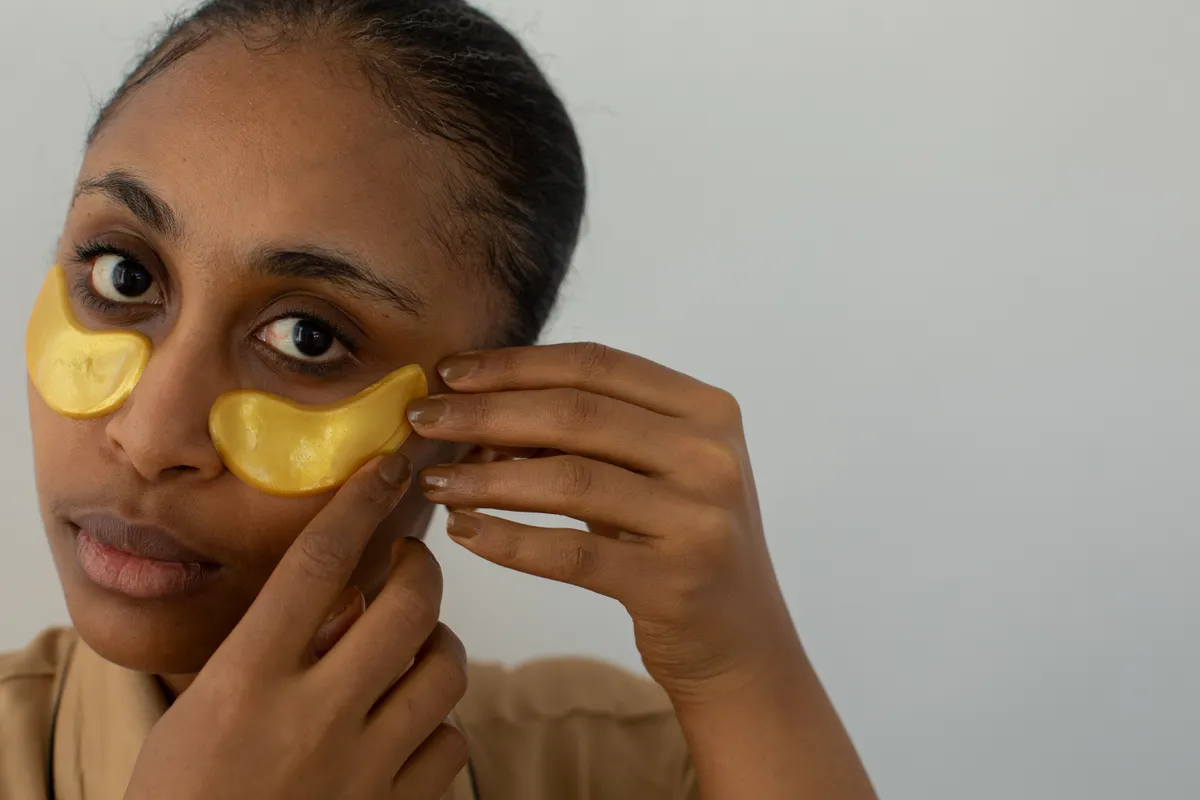

Wearing hydrogel eye patches outside has become a full-blown trend, spotted on people grabbing coffee, grinding through gym sessions, and settling into long-haul flights. But two board-certified dermatologists say where you put them on matters more than you might think.
What hydrogel eye patches actually do to your skin
Dr Toral Vaidya explains that most hydrogel patches are water- and humectant-based, relying on ingredients like hyaluronic acid and glycerin. They work through occlusion: forming a seal over the skin that traps active ingredients underneath so they absorb more effectively. ‘That occlusive seal locks in whatever is already sitting on your skin at the time of application,’ she says, ‘so they’re really designed as a controlled, at-home step, applied right after cleansing.’
Dr Dendy Engelman, who practises at Shafer Clinic in New York, puts it plainly: hydrogel patches are designed to be applied to clean, dry skin for a specific amount of time, usually between 10 and 20 minutes, depending on the product. ‘While wearing eye patches outside has certainly become a trend, from a dermatological perspective, there isn’t really an added skincare benefit to wearing them while running errands or exercising,’ she says. ‘You’ll get the most predictable results by applying them to freshly cleansed skin in a clean environment and following the product’s directions.’
Hydrogel eye patches outside the gym: skip it
If you train, this one is worth knowing. Dr Engelman says exercising in eye patches is something she would ‘generally skip’. Sweat and heat build up under the patch, moisture gets trapped against the skin, and the patch moves around, creating friction. The skin around the eyes is thinner and more delicate than most of the face, so the risk of irritation is higher.
Dr Vaidya adds that the occlusive barrier can trap sweat and excess oil, and in some cases that combination can aggravate conditions like milia. Keep the patches for the cool-down, not the session itself.
There is one setting, though, where reaching for the patches makes genuine sense: the plane. Cabin air is notoriously low in humidity, and Dr Engelman says that ‘a hydrating eye mask can provide that occlusive layer to help minimize water loss and give the eye area an immediate boost of hydration.’ Dr Vaidya agrees that dry cabin air makes a hydrating treatment appealing, but flags hygiene as her bigger concern. ‘There are more opportunities for bacteria to transfer onto your skin while performing a routine,’ she warns. The fix is simple: apply to clean skin with clean hands, and remove after the recommended wear time rather than leaving them on for the entire flight.
There is also a temperature angle worth considering. According to Women’s Health Magazine, cool temperatures help shrink blood vessels under the eyes, which can make dark circles appear lighter and reduce puffiness. Chilling your patches in the fridge before a session at home can add a physical benefit on top of the active ingredients doing their work.
How to get the most from your patches wherever you wear them
If you are not ditching the patches for your morning routine, both dermatologists give practical guidance on reducing the risks. Start with clean skin and clean hands. Follow the recommended wear time rather than leaving the patches on indefinitely: hydrogel patches are formulated to deliver their ingredients within a specific window, and leaving them on longer will not make them work harder and may increase irritation.
Dr Engelman recommends avoiding patches during strenuous exercise or anywhere you will be sweating heavily, and she is firm on one point: never reuse a single-use patch. If you notice burning, itching, redness or discomfort, remove them straight away. Once they are off and you are heading outside, apply sunscreen.
Dr Vaidya adds that because hydrogel patches are occlusive and increase absorption, layering active serums underneath them raises the chances of irritation. Keep the rest of your routine simple around them.
Brands including Rhode and Rare Beauty have brought their own versions to market, making the category more accessible than ever. Used correctly, at home, on clean skin, they are a solid addition to any recovery routine. Worn on the StairMaster? Probably leave that one.