

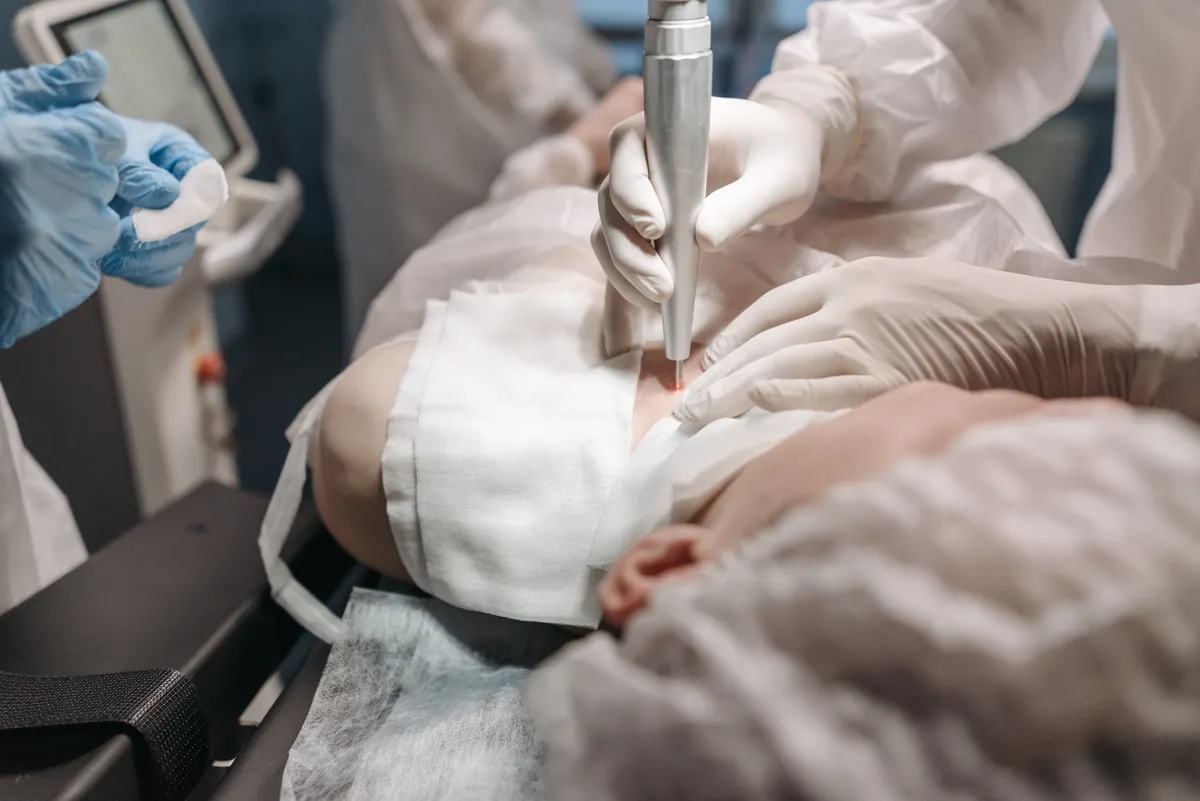

If you’re looking into laser tattoo removal on darker skin, there is a lot more to understand than the average clinic brochure will tell you, and the stakes are higher than for lighter skin tones. Painful sessions, unpredictable results, the real risk of lasting pigment damage, this is what you need to know before you book anything.
How laser tattoo removal actually works
The technology is straightforward enough. As board-certified dermatologist Bradley Glodny, MD, of Park Avenue Dermatology explains, ‘Certain wavelengths of light absorb different colours and therefore can be used to target a tattoo. The lasers break apart the pigment, then your body processes it, so with each treatment, your tattoo should become lighter.’
The type of laser matters enormously. Pico lasers have become the gold standard. Dr. Glodny says pico lasers ‘can deliver the same results in 6-8 sessions that a q-switched laser can deliver in 10-15.’ More than just speed, shorter pulse durations mean less heat generated during treatment, which is especially relevant when treating darker skin tones. You also want a practitioner with access to multiple wavelengths to target different ink colours. Board-certified dermatologist Yoon-Soo Cindy Bae, MD, of Laser and Skin Surgery Center of New York, for example, offers 535 m, 755 m, and 1064 m wavelengths to tailor each treatment plan.
Research published on PMC/NIH found that picosecond Nd-YAG laser was an effective and safe technique for professional black tattoos, with most patients seeing results in only two sessions, a figure worth keeping in mind when you’re budgeting time and money.
Laser tattoo removal on darker skin: the risks you must understand
This is where things get more complex, and where many people are not given a straight answer when they first enquire. According to Dr. Bae, ‘the lasers cannot discern between natural pigment and tattoo ink pigment, so treating darker skin types can be more challenging with more potential for discoloration.’ That means hyper- or hypopigmentation (patches darker or lighter than your natural skin tone) are a real possibility.
Dr. Glodny adds that ‘skin lightening is more difficult to address, as pigment-producing cells may have been removed or killed off during the tattoo removal process,’ and that ‘most topical lasers will not bring pigment back.’ In-office, a dermatologist may be able to prescribe topicals to help stimulate pigment production, but there are no guarantees.
The choice of laser makes a difference here. According to RealSelf, even darker skin tones do well with PicoWay, as there is a much lower chance of the laser causing hyper- or hypopigmentation compared to older technologies. Pulse Light Clinic notes that PicoWay takes versatility further by offering multiple wavelengths to target a wide range of tattoo colours and depths across varied skin tones. If you have deeper skin, asking specifically about which laser system a clinic uses (and whether it’s suitable for your skin tone) is not optional. It is the first question you should ask.
Dr. Glodny emphasises that pico lasers’ precision lessens the chances of skin pigment damage compared to q-switched alternatives, which is why your choice of practitioner and their kit both matter.
Sessions, cost and aftercare
Each session’s length depends on how many tattoos you’re removing and their size. If you’re using numbing beforehand, add around 30 minutes. Dr. Glodny recommends waiting at least two to three months after getting a tattoo before starting removal, to allow the skin to fully heal. Results are never guaranteed, as Dr. Bae puts it, ‘there’s always a spectrum.’
Cost varies hugely by location and tattoo size. For context, removing three tattoos smaller than 4 inches in New York City with numbing runs to £1,000–£2,000 per session at the higher end of the market. One small tattoo without numbing will cost considerably less.
Aftercare is non-negotiable. Dr. Bae advises treating the site as you would any wound: wash it, coat with an emollient such as Aquaphor, and cover with a bandage twice daily. Avoid saunas, pools and baths for two weeks post-session. Stick to fragrance-free soap, and do not scrub the treated area.
On the practitioner question, Dr. Glodny is direct: ‘Dermatology laser specialists will always be your best bet when looking to have your tattoo treated. They have a much deeper understanding of the technology and deliver safer treatment with less risk of burning, blistering, or hyperpigmentation.’ Look for board-certified, fellowship-trained dermatologists with access to multiple laser wavelengths. For anyone with a deeper skin tone, that last point is not a nice-to-have, it is the standard you should insist on before sitting in the chair.